Press release
Neurolcle’s Auto Deep Learning Vision Inspection Drives Quality Innovation in the Food Industry
Neurolcle’s Auto Deep Learning Vision Inspection Drives Quality Innovation in the Food Industry
Amid a series of recent food safety incidents, concerns over food production processes and overall quality management are rapidly increasing. As a result, demand for AI-based quality inspection solutions is growing at a fast pace. In particular, deep learning–based vision inspection, which overcomes the limitations of conventional visual inspection and rule-based systems, is gaining significant attention in the food industry.
Neurolcle, a specialized provider of deep learning vision inspection solutions, offers software that enables even non-experts to easily develop high-performance inspection models. At the core of Neurolcle’s technology is its Auto Deep Learning algorithm, which automatically optimizes training parameters and model architectures. Based on this technology, Neurolcle provides Neuro-T, a model training software, and Neuro-R, a runtime inference library.
Neurolcle’s deep learning vision inspection solutions are actively applied across various manufacturing industries, including food, battery, automotive, semiconductor, and steel, helping solve real-world quality challenges. According to a company representative, “Recently, we have seen a notable increase in inquiries from the food industry regarding the adoption of deep learning vision inspection solutions.”
Neurolcle Participates in OEM Quality Seminar Hosted by Daesang
Neurolcle announced that it participated in an OEM Quality Seminar exhibition last month on the 15th, hosted by Daesang, one of Korea’s leading food companies. Neurolcle was the only AI vision inspection company invited to the exhibition, demonstrating its recognized technological expertise within the industry.
At the booth, Neurolcle showcased various deep learning vision inspection use cases applicable across the entire food manufacturing process—from raw materials to processed goods and packaging—drawing strong interest from visitors.|
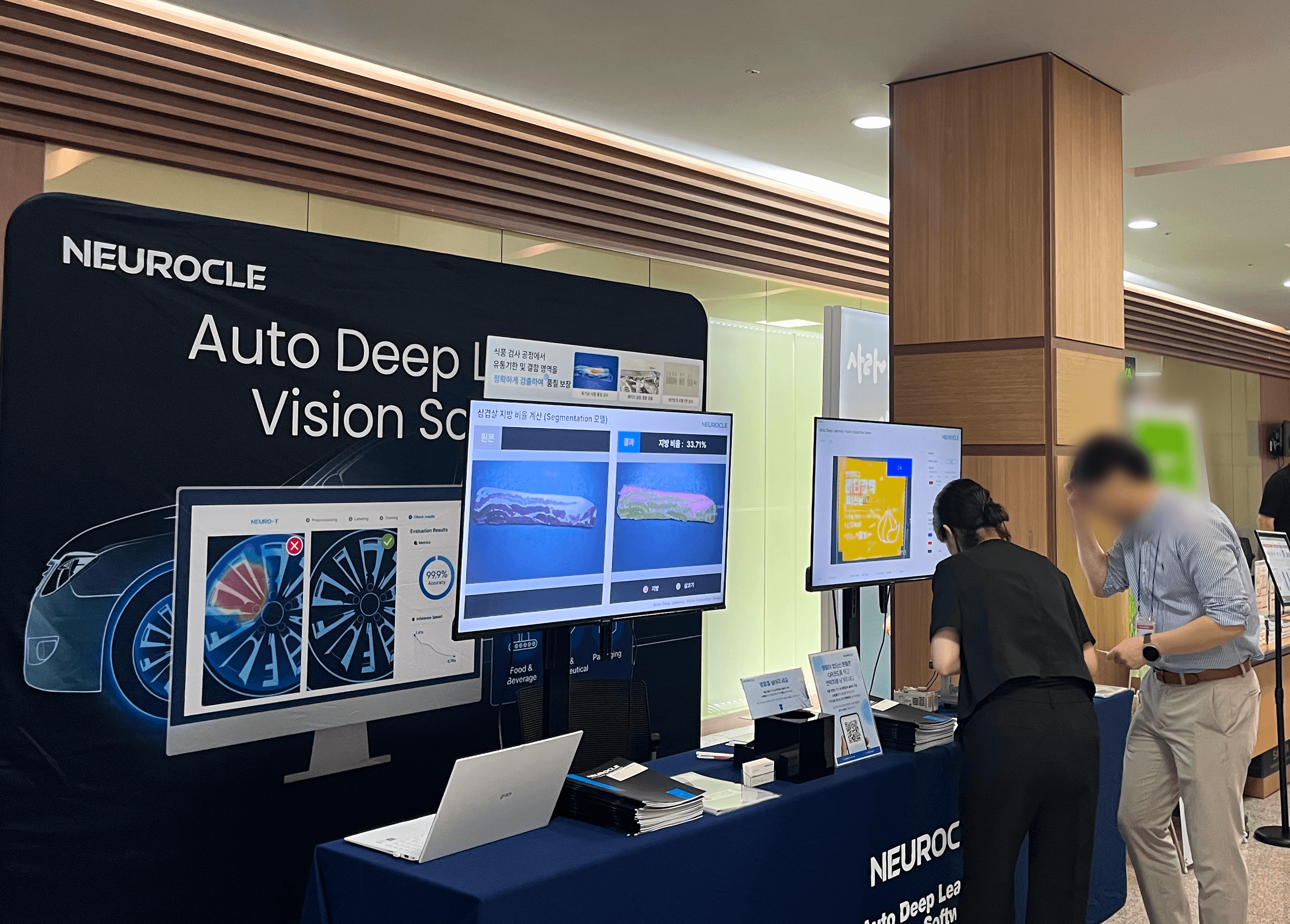
▲ Exhibition Booth Image
17% Improvement in Defect Detection Rate Using OCR Text Rules
Fresh food products such as tofu, milk, and eggs have short shelf lives, making expiration date verification a critical factor for consumers. As a result, accurate expiration date labeling is essential, and various inspection methods are used in production lines to verify print quality.
For example, Company A, a tofu manufacturer, implemented an expiration date inspection system using Neurolcle’s Auto Deep Learning solution and achieved approximately a 17% improvement in defect detection rate related to printing errors and mislabeling.
Previously, Company A used a dot-matrix printing method and identified numbers based on dot counts to inspect expiration dates. However, frequent misreads caused by print defects led to unnecessary disposal of good products and leakage of defective products. By adopting Neurolcle’s deep learning vision inspection solution and applying OCR text rules, the company effectively resolved these issues.
Neurolcle’s OCR text rule feature allows users to define custom rules during the OCR model development process. Users can configure layouts, conditions, and fixed character values, significantly improving both usability and accuracy. As a result, Company A not only enhanced productivity but also achieved consistent product quality, leading to a notable improvement in brand reliability.

▲ Expiration Date Inspection Image
98% Accuracy in Fat and Lean Meat Detection with Auto Deep Learning Vision Inspection
In the meat processing industry, factors such as fat content and intramuscular fat distribution play a crucial role in product grading, distribution, and sales strategies. Therefore, accurate inspection of fat-to-lean ratios is essential before distribution.
To address this challenge, Company B, a meat processing manufacturer, implemented a quality inspection system using Neurolcle’s Auto Deep Learning solution. As a result, inspection accuracy improved to 95% compared to conventional visual inspection methods.
Previously, Company B relied on manual inspection of sampled products, which made it difficult to consistently detect low-quality meat exceeding fat content standards. By adopting Neurolcle’s solution, the company expanded inspection coverage to all produced meat products.
First, a classification model was used to determine distribution eligibility based on fat ratio. Then, for qualified products, a segmentation model was applied to separate lean and fat regions and classify quality accordingly. Both models achieved over 98% detection accuracy, enabling Company B to establish consistent quality control across all products.
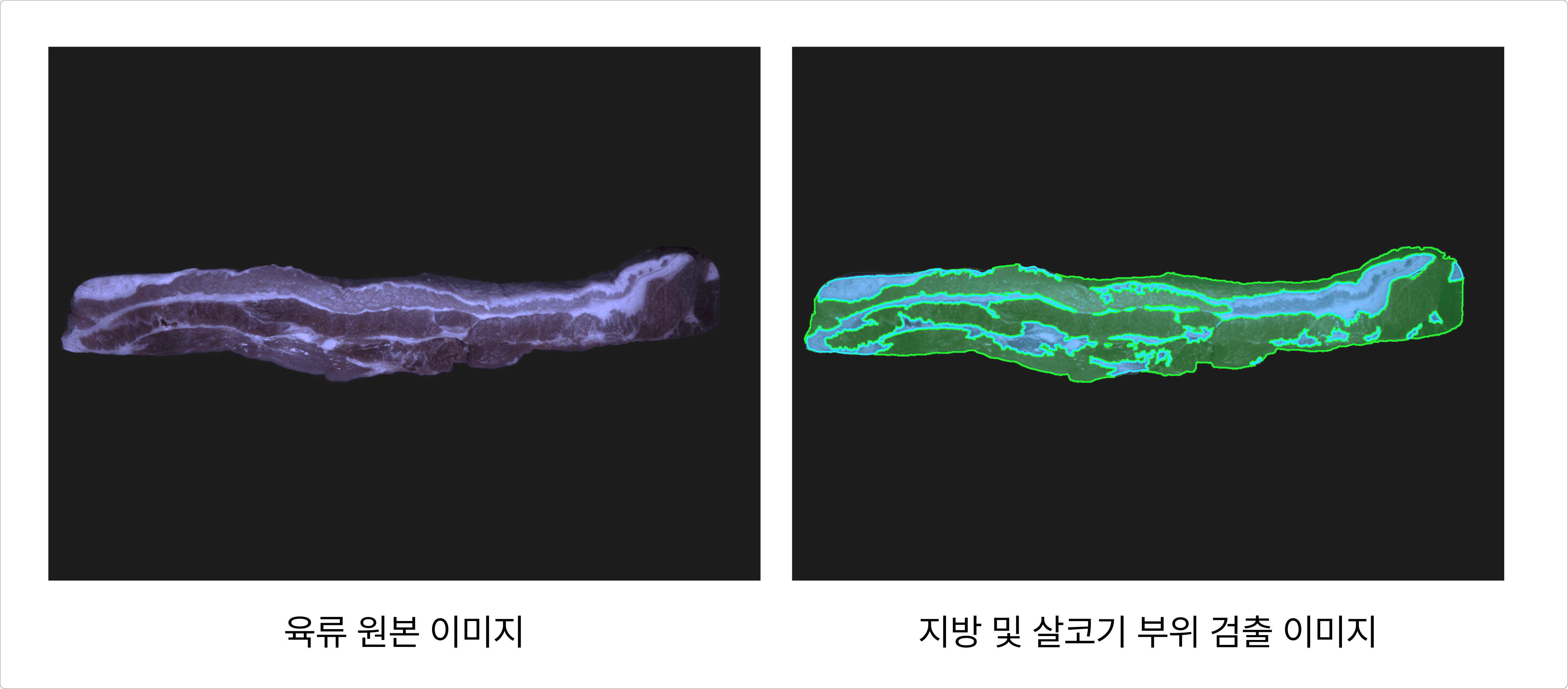
▲ Meat Quality Inspection Image
Growing Adoption of Auto Deep Learning Vision Inspection in Food Processing
Beyond the examples mentioned above, Neurolcle’s deep learning vision inspection solutions are being applied to various food processing tasks, including red ginseng grading, instant noodle defect detection, and sealing defect inspection in packaging.
CEO Hongseok Lee of Neurolcle stated, “As awareness of food safety risks continues to rise, the importance of quality inspection in the food industry will only grow.” He added, “We expect increasing adoption of Neurolcle’s Auto Deep Learning vision inspection solutions across more food processing applications in the near future.”